Why Most Software Projects Fail Before Any Code Is Written
By Nora Peterson

The most expensive software failures do not happen during development. They start much earlier, often in the first conversation, when someone says "we need an app" and everyone agrees without realizing they are each imagining something different.
By the time that misalignment becomes visible, meaningful work has already been done. Teams build features nobody explicitly asked for, overlook capabilities that were assumed to be obvious, and uncover integration requirements that should have been addressed at the outset. Projects then stretch well beyond their original timelines or are abandoned entirely because the result does not match what was expected.
In most cases, projects fail not because execution is poor, but because requirements were never clear enough to support execution in the first place.
The Real Cost of Unclear Requirements
When requirements are unclear, failures tend to follow familiar patterns. Scope expands as teams discover functionality that was assumed to be included but never specified. Features are delivered that do not address the actual problem. Integration points emerge late, forcing architectural compromises. Eventually, stakeholders realize the system does not align with what they had in mind.
The financial impact is straightforward. Building the wrong thing costs roughly the same as building the right thing, and fixing it means paying for the work a second time. A three-month project quietly becomes six months once gaps force redesign. In many cases, the opportunity cost of a delayed launch outweighs the direct development expense.
There is also an organizational impact. Teams lose confidence in their ability to deliver software effectively. Subsequent projects slow down as additional approval layers and safeguards are introduced to prevent repeat failures. Over time, the business becomes reluctant to invest in technical initiatives because prior efforts failed to deliver the intended outcome.
These organizational costs often exceed the direct rework expense.
What Makes Requirements Hard
Requirements appear simple until they need to be written with enough precision for someone else to build from them.
The challenge often begins with language. Business stakeholders describe needs in terms of outcomes. "We need users to collaborate on documents" sounds straightforward until implementation begins. Collaboration could mean simultaneous editing, comment threads, or version control. Each interpretation requires different technical architecture and creates different user experiences.
The initial request expands into dozens of decisions. Version history introduces questions about retention periods, access permissions, and whether changes can be reversed. Each answer creates new questions. This expansion from a single statement to a network of interdependent decisions happens in every domain.
Integration requirements follow the same pattern. "We need to integrate with our CRM" quickly expands into questions about data direction, sync frequency, error handling, and conflict resolution when systems disagree.
Assumptions make this harder. Stakeholders often assume their expectations are shared. Someone requesting the system assumes authentication will behave like a previous tool. The implementation team assumes a different model. Because neither side raises it explicitly, the discrepancy surfaces late, when changing the approach affects the entire system.
Edge cases are usually addressed last. What happens when a record is deleted but referenced elsewhere? When a data import fails halfway through?
These details determine whether software behaves predictably under normal operating conditions or only works in ideal scenarios.
What Separates Vague Requirements from Buildable Specifications
The difference between vague requirements and usable specifications lies in how clearly behavior is defined.
A statement like "users should be able to manage projects" sounds reasonable but leaves essential decisions unresolved. It does not define which actions are possible, which data persists, how permissions work, or how projects relate to other parts of the system.
A more concrete specification establishes boundaries. Users can create projects with a name, description, and due date. Project creators can invite other users as viewers or editors. Editors can modify project details and add tasks. Viewers can see project information but cannot make changes. Each project records a log of modifications showing what changed, who made the change, and when.
This still leaves open questions about ownership transfers, log retention, and task reassignment when users are removed. But it creates a structure that makes those gaps visible rather than hidden.
Clear requirements do not eliminate uncertainty. They surface it early, when decisions are cheaper to make.
What Happens in Morph's Requirements Phase
Morph begins with requirements clarification rather than immediate code generation because unclear requirements are where most projects fail.
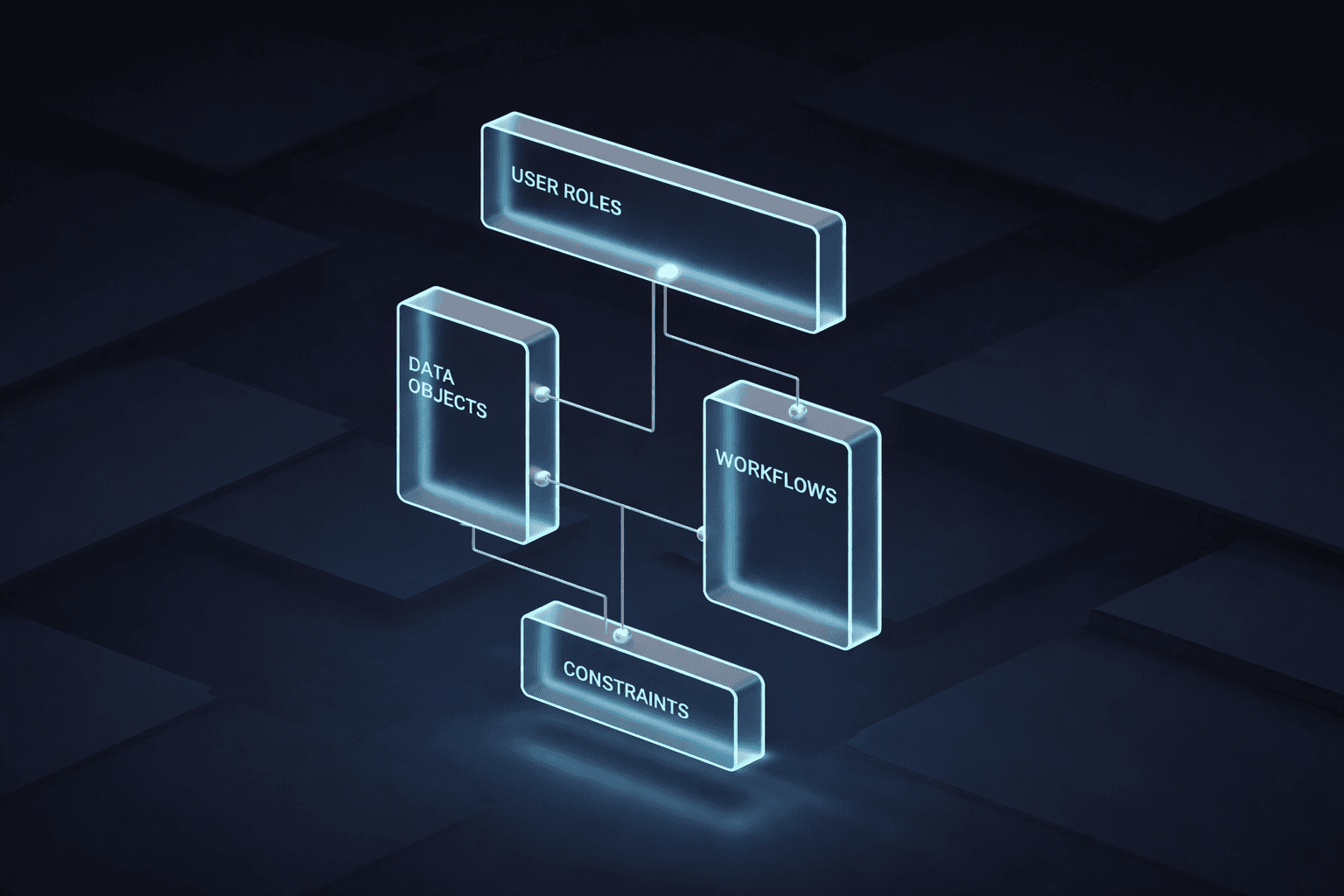
Morph treats requirements as a structured exploration designed to surface gaps before they turn into downstream issues. The process starts with a description of what needs to be built and expands it systematically to surface the details that determine whether software will work as intended. This structured approach surfaces the gaps and assumptions that typically remain hidden until after development begins.
The result is a structured specification document that defines functionality, workflows, data models, integrations, and success criteria. You review and approve this specification before implementation begins, creating a shared definition of what the delivered system should do.
This level of clarity is also what enables outcome-based pricing. Instead of paying for development cycles or revisions, teams pay for software that behaves as defined. That only works when the specification is explicit enough to validate against.
What This Enables
Clear requirements reduce several common sources of failure and create the foundation for production-ready software.
Architecture choices become grounded in actual constraints such as concurrency needs, performance requirements, and usage patterns rather than assumptions.
Integration work gets planned around identified connection points and authentication models rather than discovered as incompatibilities during late-stage development.
Validation becomes measurable because success is evaluated against agreed behavior rather than subjective impressions about system quality.
Production concerns get addressed during requirements. Edge cases become critical user journeys that define expected behavior. Data integrity, concurrency, and reliability requirements are specified before implementation. The system design identifies which production concerns can be handled autonomously and which require additional engineering work.
Addressing these issues in documentation is significantly less costly than addressing them after deployment.
What This Means for Teams Evaluating Tools
Many AI development tools prioritize rapid generation. A description is entered, code appears immediately, and teams iterate until something usable emerges.
This approach treats requirements as a precursor to the problem rather than the problem itself. As a result, output is produced quickly, but it often diverges from what was actually needed because those needs were never fully specified.
Morph prioritizes clarity before implementation. The requirements phase takes more time than instant generation, but it reduces the likelihood that the resulting system needs to be reworked.
For teams experimenting with ideas or building disposable prototypes, speed-first tools may be appropriate. For teams aiming to deploy software that supports ongoing operations, clarity during the requirements phase has a greater impact than how quickly the first version appears.
The choice depends on what you're optimizing for. If you need deployable software that solves real problems, requirements clarity is where that outcome gets determined.